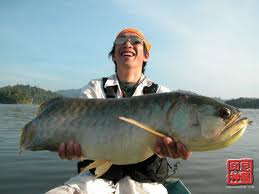
Bentuk tubuh dan warna sesirip » Bertubuh agak gempal serta kelihatan memanjang dan langsing. Manakala konfigurasi dari bahagian badan ke bahagian kepala kelihatan agak meruncing/menirus dan bersaiz normal. Kesemua sektor sesirip iaitu sepasang sirip pektoral, sepasang sirip pelvik, sirip anal, ekor dan sirip dorsal adalah berwarna merah pekat sementara ekornya berbentuk melebar dan membulat di bahagian hujungnya (berbanding Chilli Red - konfigurasinya agak menajam di hujung ekornya).
Warna sesisik » Merah pekat pegun (Blood Red matang) akan meliputi dari sektor tebing sesisik (bingkai sisik) hingga ke bahagian kedua-dua permukaan sektor pipi (sama keadaannya dengan Chilli Red). Manakala warna seakan kebiru-biru tua agak kelihatan pada permukaan sektor teras sesisiknya tanpa imbasan kilauan (warna pegun - tidak seperti Kategori Arowana Emas). Kedua-dua bebola matanya berwarna agak kuning-kemerahan serta berukurlilit agak mengecil jika dibandingkan dengan Chilli Red), manakala warna paling asas bermula dari sektor kepala ke bahagian puncak juga lazimnya hijau tua-kecoklatan.
Tuesday, February 8, 2011
Friday, February 4, 2011
Red tail Golden
Red tail golden (RTG) adalah salah satu varietas golden yang berasal dari Indonesia, khususnya Pekan baru - Sumatera. RTG sifatnya lebih agresif dari X Back. Seperti halnya X Back, RTG juga memiliki keragaman warna dasar/base color seperti, blue base, green base dan gold base. RTG dapat tumbuh lebih besar dari pada X Back.
Kekurangan dari RTG adalah warna sisik pada umumnya tidak bisa sampai melewati punggung dan hanya sampai pada level sisik ke 4 (dihitung dari bawah badan ke atas).
Harga varietas ini lebih murah dari super red, meski demikian RTG tetap memiliki kebanggaan tersendiri bagi pemiliknya.
Highback Golden Arowana
Arowana jenis Indonesian Golden berasal dari Pekan Baru, Sumatera, Indonesia. Arowana jenis ini berharga lebih murah berbanding dengan harga arowana Malaysian Golden. Ini adalah kerana warna keemasan yang terdapat pada arowana Indonesian Golden kelihatan kusam dan tidak secantik seperti Malaysian Golden.
.
Sisik keemasan pada arowana Indonesian Golden hanya mampu sampai pada baris ke 4 sahaja. Arowana jenis ini juga mempunyai variasi warna dasar yang berlainan antaranya blue base, golden base dan green base.
Arowana jenis Indonesian Golden di Malaysia lebih dikenali dengan nama Highback. Ini adalah kerana arowana jenis Indonesian Golden di Malaysia telah dikacukkan dengan arowana jenis Malaysian Golden. Jadi arowana jenis Highback mempunyai warna emas yang lebih cantik dan sisik keemasannya mampu mencapai sehingga baris ke 5.
Jika bernasib baik, sisik keemasan arowana jenis Highback ini mampu mencapai baris ke 6 dan dipanggil Super Highback dan harganya lebih mahal dari jenis Highback. Terdapat pelbagai nama untuk arowana Indonesian Golden antaranya Red Tail Golden (RTG), Highback dan Highback Red Tail Golden (HBRTG). Walaupun digelar dengan pelbagai nama ia tetap adalah spesis yang sama iaitu Indonesian Golden.
.
Sisik keemasan pada arowana Indonesian Golden hanya mampu sampai pada baris ke 4 sahaja. Arowana jenis ini juga mempunyai variasi warna dasar yang berlainan antaranya blue base, golden base dan green base.
Arowana jenis Indonesian Golden di Malaysia lebih dikenali dengan nama Highback. Ini adalah kerana arowana jenis Indonesian Golden di Malaysia telah dikacukkan dengan arowana jenis Malaysian Golden. Jadi arowana jenis Highback mempunyai warna emas yang lebih cantik dan sisik keemasannya mampu mencapai sehingga baris ke 5.
Jika bernasib baik, sisik keemasan arowana jenis Highback ini mampu mencapai baris ke 6 dan dipanggil Super Highback dan harganya lebih mahal dari jenis Highback. Terdapat pelbagai nama untuk arowana Indonesian Golden antaranya Red Tail Golden (RTG), Highback dan Highback Red Tail Golden (HBRTG). Walaupun digelar dengan pelbagai nama ia tetap adalah spesis yang sama iaitu Indonesian Golden.
Banjar Red Arowana
Arowana Banjar Red berasal dari Banjar Masin, Indonesia. Arowana jenis ini dikelaskan sebagai arowana merah kelas ke dua. Walaupun dipanggil dengan perkataan "Red" arowana jenis ini tidak mempunyai sedikit pun warna merah pada keseluruhan warna fizikalnya.
.
Warna badannya sedikit kehijauan dan kekuningan manakala hujung sirip atas dan bawah serta ekornya berwarna kuning ataupun oren. Walaupun harganya murah tetapi arowana jenis Banjar Red ini memiliki peminatnya yang tersendiri kerana warna ekornya yang terang serta bentuk badannya yg menarik.
Semasa kecil arowana jenis ini lebih mirip kepada arowana jenis Super Red. Ini adalah kerana sirip atas dan bawah serta ekornya berwarna merah sama seperti anak arowana Super Red. Amat sukar untuk membezakan arowana jenis Banjar Red dan Super Red ketika masih kecil.
.
Apabila meningkat dewasa barulah berlaku perubahan warna yang ketara pada sirip, sisik dan ekornya. Arowana Banjar Red yang mencapai umur matang mempunyai warna kehijauan dan kekuningan pada sisik badan. Hujung sirip atas dan bawah serta ekornya pula berwarna kuning atau oren.
.
Warna badannya sedikit kehijauan dan kekuningan manakala hujung sirip atas dan bawah serta ekornya berwarna kuning ataupun oren. Walaupun harganya murah tetapi arowana jenis Banjar Red ini memiliki peminatnya yang tersendiri kerana warna ekornya yang terang serta bentuk badannya yg menarik.
Semasa kecil arowana jenis ini lebih mirip kepada arowana jenis Super Red. Ini adalah kerana sirip atas dan bawah serta ekornya berwarna merah sama seperti anak arowana Super Red. Amat sukar untuk membezakan arowana jenis Banjar Red dan Super Red ketika masih kecil.
.
Apabila meningkat dewasa barulah berlaku perubahan warna yang ketara pada sirip, sisik dan ekornya. Arowana Banjar Red yang mencapai umur matang mempunyai warna kehijauan dan kekuningan pada sisik badan. Hujung sirip atas dan bawah serta ekornya pula berwarna kuning atau oren.
Green Arowana
Green Arowana is a large fresh water fish with numerous primitive features. It is, indeed a member of the most ancient group of fish, and has been labelled as a relict fish, a living fossil and so forth. Kelesa is characterized by an elongated body, well-developed outsized stout bony scales, large eyes, a bony covering on the head, and deeply oriented pectoral fins. Its body is greatly compressed along the sides, and its belly is keeled. The gape of its mouth is very large and steeply inclined, being directed diagonally upward. The jaws have a row of small pointed teeth. Two small barbels are present on its lower jaw, these are extendable and can touch objects around the fish. Its dorsal fin is located near the tail end. It is smaller than the anal fin which has an origin in front of it. The edges of the dorsal, caudal and anal fins are rounded.
Habit and Habitat: The Kelesa is a predatory fish inhabiting quiet, clear waters, usually singly but sometimes in small schools. It is generally to be found near weeds, rushes and particularly those pockets in the bank where leaves and driftwood collect and where there is often a fallen tree.
Food habit: It feeds chiefly on insects, and large specimens prey upon other fishes. Its diet has also been described to include worms, spiders, small lizards, small snakes and frogs.
Distribution: It was first described by Miller and Schlegel in 1845 from a specimen from River Doeson, Borneo. The first record in Peninsular Malaysia appears to be in 1992. In addition to Peninsular Malaysia and Borneo, it also occurs in Thailand, Cambodia, and Sumatra in rivers and lakes.
Status: A protected species in Sarawak.
Thursday, February 3, 2011
Silver Arowana
The Silver Arowana is of the genus “Osteoglossum bicirrhosum,” were recognized as a new fish species in 1829 in France, by zoologist Georges Cuvier. They are classified as Bony-Tongued Fish which are fish that go back to somewhat pre-historic times. In fact, in Greek, Osteoglossum is bone-tongued and bicirrhosum is "two barbels.”
Silver Arowana are found naturally in white and black water floodplains of South America in the freshwaters of the Amazon River Basin and River, maybe in the Rupununi and Oyapock Rivers, and in some still waters of Guyana as well. There is indication that they don’t go through rapids, as they haven’t promulgated further upstream. Most of the Silver Arowana are found in the swamp and flooded areas in the shallower water.
Silver Arowana are primitive, prehistoric fish. They actually have teeth on their tongue that comprise the bite they have for their food. Other relatives of Arowana in general include the Butterfly fish and Elephant fish.
Silver Arowana are among the cheapest Arowana available, and the least restricted to import/export. They come small, but look out, they grow rapidly. It is wise to get them at 4-8 inches/ 10-20cm when they are hardier and easier to handle. This will give you a better chance of success keeping them.
The natural environment of the Silver Arowana is from about 75 to 82 degrees F (24-28 C) warm in the water. In the wild, Silver Arowana may reach upwards of 4 feet /120 cm in length, and a little over ten pounds in weight.
They require good water condition to flourish. You must keep Ammonia and Nitrites close to zero. Silver Arowana create a lot of waste, so the filtration system needs to be strong and efficient. Changing at least 25% of the water per week is advisable. Some even recommend as much as 50-75%. The pH of the water (soft and acidic) is best kept between 6.0 and 6.9. Water hardness level for an ideal environment is about 1-8dH.
Their body are covered in very big, strong, and bony scales, and at the lower jaw, 2 barbels. Silver Arowana have a large, bony tongue. The dorsal and anal fins are nearly connected to the caudal fin. Adult Silver Arowana is silvery usually whereas the juveniles often have a yellow-orange bar on the side. They have longer fins than the other Arowana species from Australia, Asia, and Africa.
The growth rate in the Silver Arowana is about two inches (5cm) a month during their first year.
Juvenile Silver Arowana - Osteoglossum bicirrhosum.
Silver Arowana requires a larger aquarium tank that needs to be well covered to prevent the fish from jumping out if the aquarium to their deaths. The size required depends on the size of your Arowana but should as a rule be at least twice and preferable more than 3 times the length of the fish. Decorated the aquarium so that a lot of open space is created to allow your Silver Arowana fish space where they can swim freely. Silver Arowana like their space to move about in (above). You will however probably want to give them a couple of places where they can hide. While some tank mates may be good for dinner, you might try some other large fish that are hardy and slightly aggressive fish such as Catfish to keep with your Arowana.
Silver Arowana fish demands a varied diet. They are usually fed guppies in the stores where they are sold and whatever it takes upon acclimation to get them to eat other things is wise and necessary to get them to do so. Getting them to eat non-live food can be a good thing too, as it expands your options for variety. They will usually eat things such as frozen raw shrimp, squid, scallops, and fish fillets. They will also accept a number of live foods such as, smaller fish, plankton, crickets, bloodworms, other insects, and mosquito larvae. If trained, they will eat nearly anything they can get their hands on. Goldfish might be suggested as a snack, however they should not make up a too large part of your Silver Arowana’s diet. Another aspect, if you dare, is to attempt to get them to fetch food from your hand which can result in some painful bites until the Arowana learns it.
One condition that is often seen in Silver Arowana is called “Drop Eye”, where an eye appears to look downward. It seems this may be the result of over breeding at the breeders though it might also come from fatty tissues behind the eye. Less fat in their diet may help to minimizing or preventing this.
Make sure the top of your tank is well secured. Silver Arowana are Jumpers, and may wind up dead on the floor otherwise.
They can be shy, and easily spooked. For example, when turning on the lights, it is wise to turn on the room lights first. Then after a few minutes, turn on the tank lights. Otherwise, your Silver Arowana might get spooked and injure itself. It is good if you can get some sunlight to them in the day as well, but not constant or you might wind up with an algae problem.
Adult Silver Arowana - Osteoglossum bicirrhosum.
It is suggested for filtration to use adequate Mechanical, Chemical, and Biological filtration to cover the amount of water in the tank. Multiple units might not hurt considering the volume of water you need for your Silver Arowana, and it does provide backup in case one system fails.
On a closing note, you should also remember, Silver Arowana’s are not for the poor, or the inexperienced aquarist. However, they are very interesting fish to watch grow, and live. They will undoubtedly give you many hours of enjoyable scenery, and experiences. If you choose to get a Silver Arowana, it is wise to do a lot of research to become even more experienced with these great living examples of the Amazon Basin.
Wednesday, February 2, 2011
Subscribe to:
Comments (Atom)